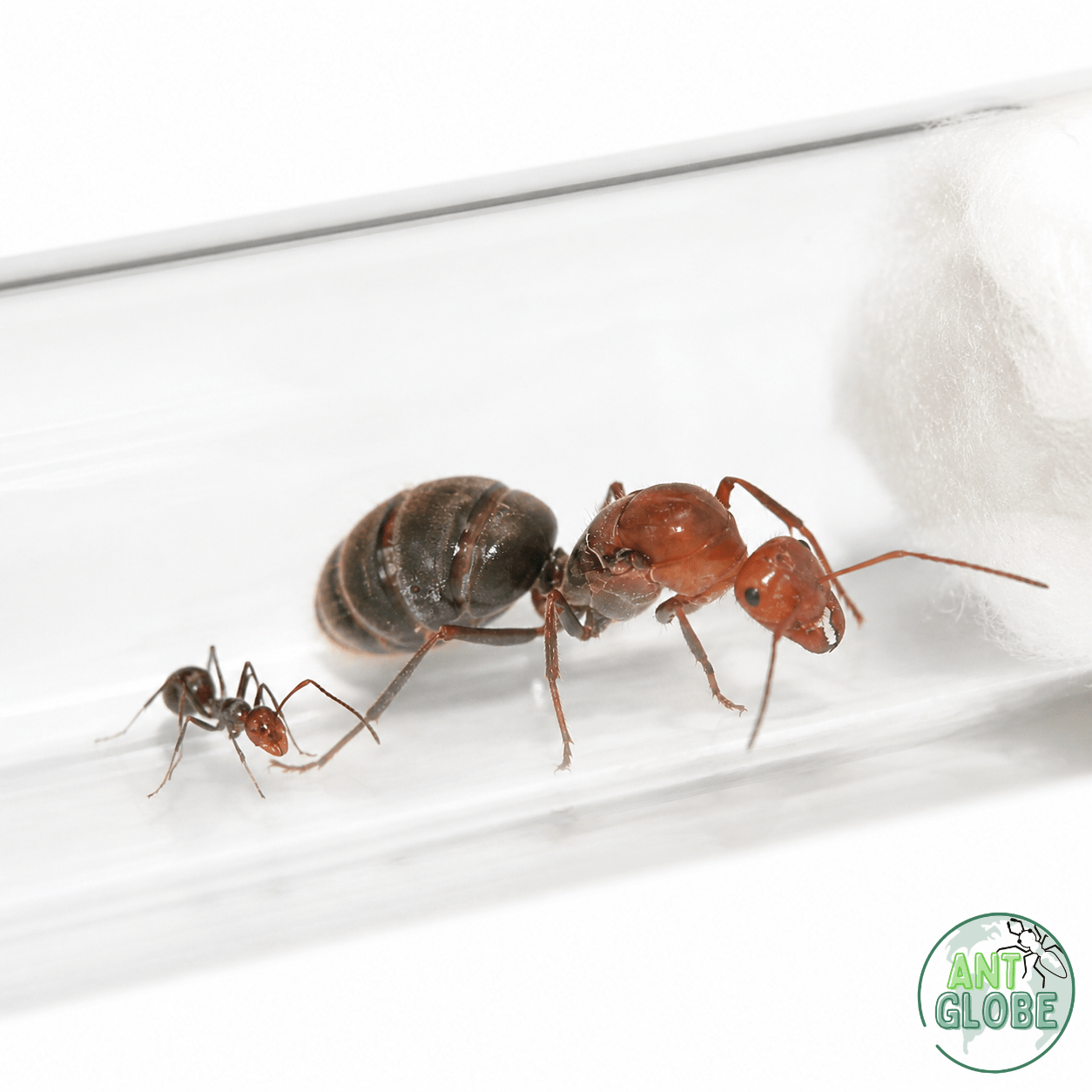
The Myrmecocystus mendax, known as the Bicolored Honeypot Ant, is a high altitude specialist of the American Southwest and Mexico. While often confused with M. mimicus, M. mendax is typically more robust and exhibits fascinating social flexibility. In some mountain ranges, they are strictly monogyne (one queen), while in others, they are known to practice primary polygyny, where multiple unrelated queens work together to start a massive super-colony. They are the rugged “mountaineers” of the honeypot world, favoring rocky clay soils over the loose sand of the lowland deserts.
Technical Specifications
| Feature | Details |
| Origin | North America (SW USA to Central Mexico) |
| Habitat | Pinyon-Juniper woodlands, scrubsteppes, and mountain ridges |
| Colony type | Monogyne or Polygynous (Varies by population) |
| Queen size | 12mm – 14mm (Deep red head/thorax, dark gaster) |
| Worker size | 4mm – 8mm (Bicolored and highly polymorphic) |
| Nutrition | Constant liquid sugars and various insect proteins |
| Humidity | Nest: 50% – 70% | Outworld: 40% – 60% |
| Temperature | Nest: 22°C – 26°C | Outworld: 23°C – 30°C |
| Hibernation | Optional (Winter rest at room temp/15°C recommended) |
| Difficulty | 4/5 (Intermediate, requires specific substrate/heat) |


Reviews
There are no reviews yet.