Best Ant Species for Beginners in Europe
Choosing your first ant colony can be surprisingly difficult. There are hundreds of species available to ant keepers, but that does not mean they are all equally suitable for a first setup.
For most people in Europe, a few species stand out for very good reasons. Lasius niger is probably the safest overall choice for a first colony, while Messor barbarus is a great option if you are fascinated by seed-harvesting ants. Formica fusca is worth looking at if you want something more active, and Camponotus ligniperda makes sense for beginners who would rather keep large ants and do not mind slower colony growth.
The important thing is that there is no single “best ant” for everyone. The right choice depends on what you want to see, how patient you are and how much space you have.
Quick Answer: Which Ant Is Best for a Beginner?
For a typical European beginner, I would rank the four species like this:
| Species | Difficulty | Activity | Growth | Hibernation | Best for |
|---|---|---|---|---|---|
| Lasius niger | Very easy | High | Moderate to fast | Yes | Absolute beginners |
| Messor barbarus | Easy–moderate | High | Moderate | Seasonal rest | Seed-harvesting behaviour |
| Formica fusca | Easy–moderate | Very high | Moderate | Yes | Active colonies |
| Camponotus ligniperda | Easy–moderate | Moderate | Slow | Yes | Large ants and patient keepers |
That ranking is not meant to suggest that one species is objectively superior. It is more useful to think of it as four different ways to start the hobby.
For most people who simply want to learn the basics without making things unnecessarily complicated, Lasius niger is still the one I would start with.
What Makes an Ant Species Good for Beginners?
An easy species is not necessarily one that requires zero care. Good beginner ants are species that give you some room to learn.
A few characteristics make a big difference:
Hardiness. Your first colony will probably encounter a mistake or two. That is normal.
Simple founding behaviour. A fully claustral queen can raise her first workers without being fed, which removes one of the easiest ways for a beginner to interfere too much.
Suitable climate. European species are naturally adapted to seasonal European conditions. That means you are generally not trying to recreate a tropical environment in your bedroom.
Manageable colony growth. Extremely fast-growing colonies can become difficult surprisingly quickly.
Interesting behaviour. An easy species is even better when you actually enjoy watching it.
This is one reason a generic list of “easy ants” is not particularly useful. A species can be biologically easy while still being a poor choice for you.

1. Lasius niger – The Safest First Choice
Lasius niger, commonly called the black garden ant, is the classic European beginner species.
And honestly, there is a reason this recommendation appears again and again.
It is widespread across Europe, commonly occurs around human habitation, and is well documented. AntWiki describes it as one of the commonest European ant species, with colonies ranging from several hundred to around 10,000 workers in its natural history summary.
Why Lasius niger is so good for beginners
The founding stage is the biggest advantage.
A newly mated queen can found a colony claustrally. In practical terms, she does not normally need you to feed her while raising the first workers. That means you can put her in a suitable test tube setup, provide water, reduce disturbance and let her do what she is biologically adapted to do.
That sounds simple, but it matters enormously for a first-time keeper.
Beginners often want to check the queen every few hours, add food, change the setup or move her because nothing appears to be happening.
With a founding Lasius niger queen, doing less is often better.
The species is also well adapted to European conditions and can be kept without creating an artificial tropical environment. Its natural range and habitat include towns, villages, open woodland, pasture and other disturbed habitats.
The downside
There is one thing new keepers sometimes underestimate.
Small ants are easy to overlook but also easy to underestimate when it comes to containment.
Lasius niger workers are only around 3.5–5 mm long, according to AntWiki, so escape prevention needs to be taken seriously.
And although the early colony may seem tiny and almost boring, it will not stay that way forever.
A healthy colony can eventually become a very busy setup. That is great if you enjoy watching a large foraging workforce, but it means your tiny starter setup will eventually need to evolve.
Best for
Absolute beginners who want the simplest possible introduction to ant keeping.
2. Messor barbarus – Best for Seed-Harvesting Behaviour
Messor barbarus is probably the most interesting alternative to Lasius niger for many European beginners.
These are harvester ants, and their behaviour is completely different.
Instead of simply watching workers hunt insects and collect sugary foods, you can watch them gather seeds, transport them back to the nest and build seed stores.
Messor barbarus is native to parts of the western Mediterranean region, including Spain, Portugal, France and Italy.
The species also has striking variation between worker sizes, including large major workers, which makes established colonies especially interesting to watch.

Why beginners like Messor barbarus
The obvious answer is the seeds.
There is something very satisfying about watching a colony create its own little food-storage system.
It also looks dramatically different from a basic black garden ant colony.
You get different worker sizes, visible food storage and interesting foraging behaviour. That gives the colony plenty of character.
But Messor is not completely foolproof
This is where beginner lists sometimes oversimplify things.
Messor barbarus is easy enough for a beginner, but it has different requirements from Lasius niger.
The ants need access to suitable moisture while also having sufficiently dry areas. Their natural foraging activity is strongly influenced by temperature, and research summarized by AntWiki reports particularly high activity when surface temperatures are approximately 15–35°C.
The seed stores also mean you need to think about humidity differently. You do not want to turn the entire nest into a damp environment around stored seeds.
And while seeds are the defining food source, a growing colony still benefits from appropriate protein.
So I would describe Messor barbarus as easy to moderate, rather than pretending it is exactly as simple as Lasius niger.
Best for
Beginners who want interesting behaviour and would rather watch a colony harvest seeds than simply forage around for food.
3. Formica fusca – Best for Active Colonies
If you find small Lasius ants difficult to watch, Formica fusca is worth considering.
Workers are noticeably larger and tend to be very active, which makes everyday colony behaviour easier to see.
Formica fusca is widespread across Europe and occurs in a range of habitats including woodland edges, meadows and other open or semi-open environments. Scientific literature describes it as a widespread European species with a broad ecological range.
Hobby keepers also commonly recommend it as a beginner species because it combines fairly straightforward care with a lot of visible activity.
Why I like Formica fusca for beginners
You tend to see the workers doing things.
Foraging.
Exploring.
Moving brood.
Responding to food.
That makes it a particularly rewarding species if your main reason for getting ants is observation.
The workers are also larger than Lasius niger, which makes them easier to see and usually easier to appreciate through the glass of a small formicarium.

The catch
Formica species can be quick and energetic.
That is great for observation, but it also means your setup needs to be properly secured.
You should also understand that care information for Formica fusca can vary between sources and local populations, so I would not treat one temperature or humidity figure as a universal rule.
And, like many temperate European ants, seasonal dormancy is part of the natural annual cycle.
Best for
Beginners who want a lively colony and find larger, more active ants more appealing than tiny Lasius.
4. Camponotus ligniperda – Best for Beginners Who Want Large Ants
There is a very simple reason people choose Camponotus:
They are big.
Camponotus ligniperda is a large European carpenter ant and can be particularly impressive compared with smaller beginner species. AntWiki gives workers ranging from roughly 6–14 mm and describes the species as occurring across a large part of Europe.
It is found in habitats including forests and other wooded environments, with nests associated with dead wood and stumps.
Why it can be a great first colony
Large workers are simply easier to appreciate.
You can see their behaviour clearly, and an individual ant does not disappear visually the moment it moves across the nest.
They also tend to be a good match for someone who prefers a slower hobby.
Camponotus ligniperda is not a species I would recommend to someone who wants explosive colony growth within a few months.
But that can actually be an advantage.
A slower-growing colony gives you more time to learn.
The downside
Patience.
This is probably the biggest adjustment for somebody coming into ant keeping expecting a rapidly expanding colony.
Camponotus ligniperda also follows a seasonal cycle and requires winter dormancy in captivity. Husbandry guides commonly recommend a cool winter period, often around 5–10°C, although exact timing and conditions depend on the colony and local climate.
Best for
Patient beginners who want large, impressive ants and do not mind slower colony development.
Which One Should You Choose?
This is probably the most useful way to look at it:
“I just want the easiest first colony.”
Choose Lasius niger.
It is hardy, widespread, well studied and very forgiving for a first-time keeper. Its claustral founding stage also makes the first few weeks particularly straightforward.
“I want something visually interesting.”
Choose Messor barbarus.
The seed storage, worker size variation and foraging behaviour give the colony a lot of character.
“I want to see ants doing things all day.”
Choose Formica fusca.
It is a more active option and the workers are large enough to observe easily.
“I want big ants.”
Choose Camponotus ligniperda.
Just be prepared to wait.
My overall ranking
For a typical beginner in Europe, my order would be:
1. Messor barbarus
2. Lasius niger
3. Formica fusca
4. Camponotus ligniperda
That does not mean number four is “bad”. It simply reflects how forgiving and straightforward each option is for a completely new keeper.
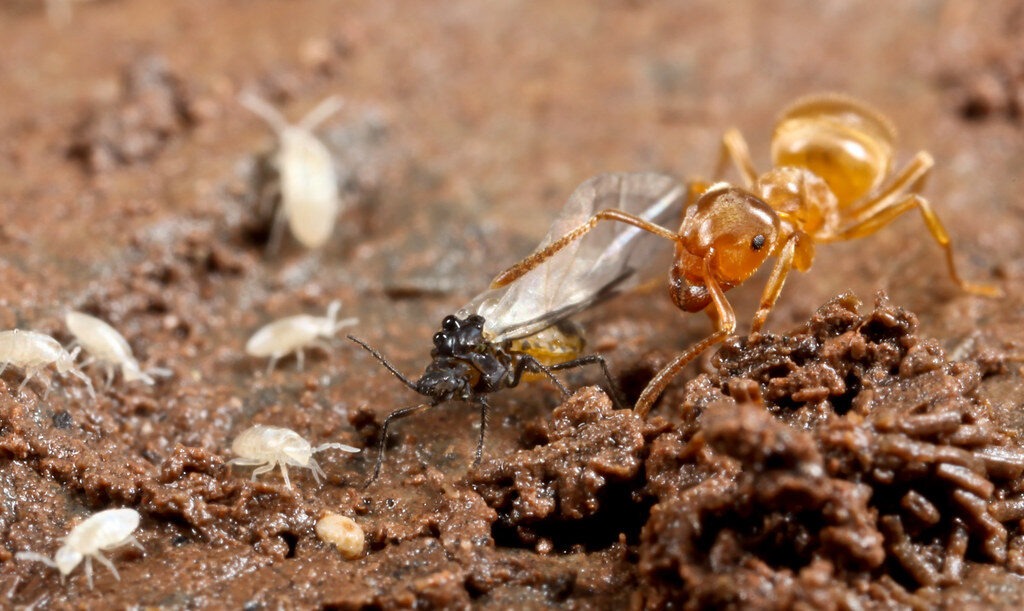
What About Lasius flavus?
Lasius flavus deserves an honourable mention.
It is a common European species, fully claustral during founding and generally considered beginner-friendly.
There is one major reason I would not put it above Lasius niger for most beginners, though:
It spends a lot of its life underground.
In a natural environment that makes perfect sense.
In a formicarium, it can mean you buy a healthy colony and then wonder why hardly anything seems to happen.
That does not necessarily mean something is wrong.
It is simply a quieter species to observe.
For someone interested in natural underground behaviour, that is actually a positive.
For someone buying their first colony because they want to watch ants constantly, Lasius niger is probably the better choice.
Do Beginner Ants Need Hibernation?
Many European beginner species do.
That is something you should understand before buying a colony.
Temperate ants have evolved around seasonal changes. Winter dormancy, often called hibernation or diapause in the hobby, is part of that cycle.
Lasius niger, Formica fusca and Camponotus ligniperda are examples where a winter rest is an important part of normal husbandry. Hobby care sources commonly use a cool winter period for these species rather than keeping them warm and fully active throughout the year.
The exact temperature and timing should not simply be copied from a random care sheet.
Your geographic location, colony condition, species and season all matter.
The good news is that once you understand the concept, it is not particularly complicated.
You are basically allowing the colony to experience winter instead of trying to force it to behave like a tropical species.

Should You Start With a Queen or a Colony?
For someone completely new to ant keeping, I generally prefer a small established colony when available and legally sourced.
Why?
Because a founding queen can be extremely rewarding, but the founding stage can also be nerve-racking for a beginner.
You might spend weeks staring at a test tube wondering whether the queen is behaving normally.
With a small colony that already has workers, you immediately get something to observe while also learning the basics of feeding, hydration and containment.
There is still something special about raising a colony from a single queen, though.
For that reason, Lasius niger is especially attractive. Its founding biology makes the process considerably less complicated than it might initially seem.
The Equipment You Actually Need
One of the easiest mistakes is buying too much equipment too early.
You do not need a giant formicarium for a tiny colony.
In fact, putting a small colony into a huge nest can create more problems than it solves.
For most beginner species, the starting setup can be surprisingly simple:
- A suitable test tube or founding setup
- A small feeding/foraging area when required
- A reliable escape barrier or secure lid
- A suitable carbohydrate source
- Protein food appropriate for the species
- Water
- Species-appropriate nest conditions
That is it.
The fancy multi-level formicarium with bridges, decorations and multiple chambers can come later.
Your first goal is not to build an impressive ant mansion.
Your first goal is to keep the colony healthy.
Common Mistakes New Ant Keepers Make
Moving the colony too quickly
A tiny colony does not need a giant nest.
Let the colony grow into its housing rather than forcing the colony to live in empty space.
Disturbing a founding queen
This is especially common with newly captured or purchased queens.
Constant checking creates more stress and does not make the brood develop faster.
Sometimes the best thing you can do is leave the test tube alone.
Keeping everything too wet
Moisture requirements vary by species, and more moisture is not automatically better.
Messor barbarus is a particularly good example because its seed storage makes moisture management important.
Skipping winter dormancy
This is one of the biggest mistakes with temperate European species.
The fact that an ant can physically survive at room temperature does not mean that keeping it fully active year-round is good husbandry.
Buying a species because it looks impressive
A huge tropical species might look incredible online.
That does not make it a good first colony in a European bedroom.
Start with the conditions you can realistically provide.

Frequently Asked Questions
What is the easiest ant species for beginners in Europe?
For most beginners, Lasius niger is the strongest overall choice. It is widespread, hardy, well documented and has a straightforward claustral founding stage.
Is Messor barbarus good for beginners?
Yes. Messor barbarus is a very popular beginner option, particularly for people who enjoy seed-harvesting behaviour and large, varied worker castes. It is slightly more specialised than Lasius niger, particularly regarding moisture management.
Is Formica fusca beginner-friendly?
Yes. It is widely regarded by European keepers as a robust and active beginner species. Its larger, energetic workers also make it easy to observe.
Is Camponotus ligniperda good for a first colony?
It can be. It is particularly suitable for a beginner who likes large ants and does not mind slower growth. It is a European species with a seasonal cycle and winter dormancy requirements.
Which beginner ant grows fastest?
That is difficult to answer with one universal ranking because colony growth depends heavily on species, temperature, food, colony age and individual colony condition. A species that grows quickly for one keeper can develop much more slowly for another.
Do all European ants need hibernation?
No. European ant species are diverse, so you should not assume that every species follows the same seasonal cycle. Always research the specific species rather than applying one rule to every ant.
Should I buy a queen or a colony?
Both can work. A queen is more rewarding if you want to experience the entire founding process, while a small established colony can make the first months easier and gives you something to observe immediately.
Final Thoughts
Choosing your first ant colony does not need to be complicated.
For most beginners living in Europe, Lasius niger is still the easiest place to start. It is hardy, widespread and forgiving, and the founding stage is wonderfully simple.
But it is not your only good option.
Messor barbarus is more unusual and gives you fascinating seed-harvesting behaviour. Formica fusca is a great choice if activity matters to you. And Camponotus ligniperda is an excellent fit for someone who wants big ants and is happy to be patient.
The best first colony is ultimately the one that fits your expectations.
That matters more than chasing a species simply because someone called it “the best.”
Start small. Learn the basics. Give the colony time.
And resist the temptation to build the biggest formicarium you can find on day one.
Your ants will tell you when they need more space.