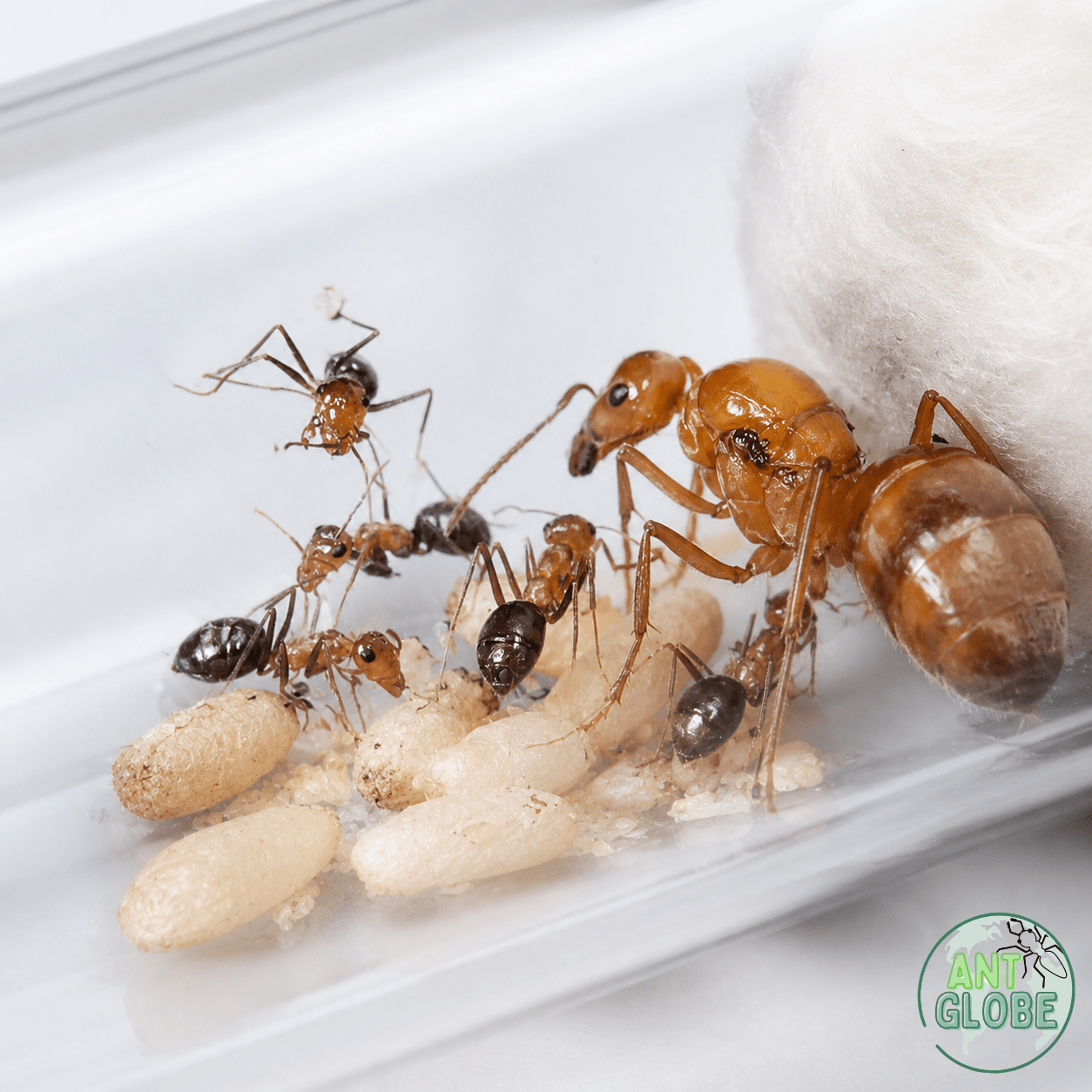
The Myrmecocystus romainei, known as the Romaine’s Honeypot Ant, is a rare and visually striking treasure of the American Southwest. Often characterized by a “fuzzy” or matte appearance due to fine body hairs, they sport a beautiful contrast between a reddish-tan head and thorax and a deep black abdomen. While they are a medium-sized species within the genus, they are legendary for producing exceptionally large, brilliant golden repletes. They are the “desert scouts,” found in a variety of high and low desert habitats, known for being active, curious, and remarkably resilient.
Technical Specifications
| Feature | Details |
|---|---|
| Origin | Southwestern USA (Arizona, Nevada, New Mexico, Utah) |
| Habitat | Fine deep sand or compact clayey soil; prairies and woodlands |
| Colony type | Monogyne (One queen per colony) |
| Queen size | 11mm – 13mm (Reddish with a dark gaster) |
| Worker size | 4mm – 8mm (Polymorphic; matte reddish-brown and black) |
| Nutrition | High sugar requirement (Honey/Nectar) and insect protein |
| Humidity | Nest: 50% – 60% | Outworld: 30% – 50% |
| Temperature | Nest: 23°C – 27°C | Outworld: 24°C – 32°C |
| Hibernation | Facultative (Optional winter rest at ~15°C) |
| Difficulty | 3.5/5 (Intermediate; sensitive to stability) |


Reviews
There are no reviews yet.