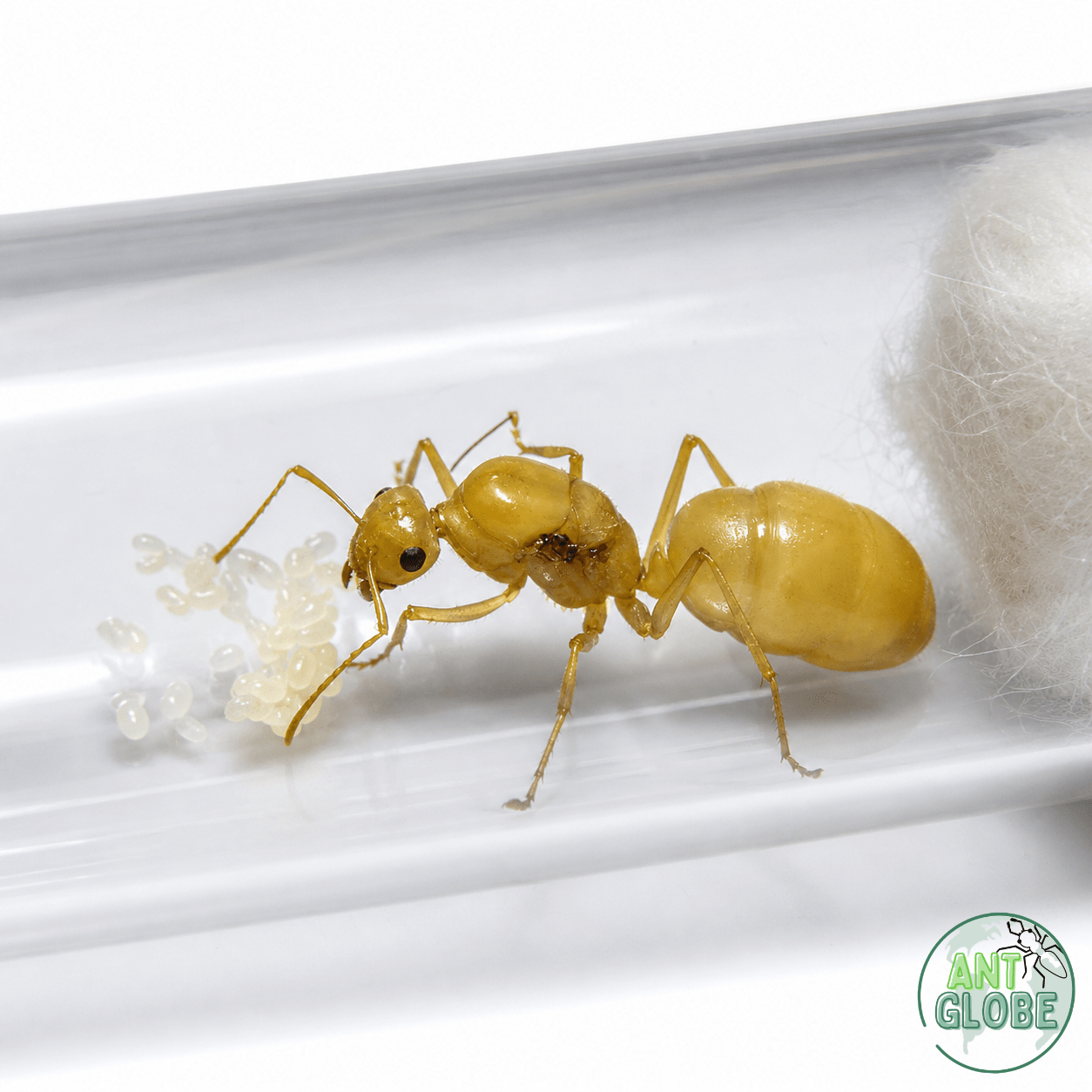
The Myrmecocystus navajo, often referred to as the Navajo Honeypot Ant, is a smaller but incredibly hardy member of the honeypot family. Native to the high-altitude deserts and plateaus of the American Southwest, they are built for extreme conditions. While they are more compact than the giant M. mexicanus, they are prolific producers of “repletes.” These ants are easily identified by their beautiful, uniform orange-amber color and their slightly more “squat” build. If you want the honeypot experience in a more manageable, space-efficient colony, the M. navajo is the perfect choice.
Technical Specifications
| Feature | Details |
| Origin | Southwestern USA (AZ, NM, UT, CO) |
| Habitat | High desert, sandy plateaus, and juniper-sagebrush scrub |
| Colony type | Monogyne (One queen per colony) |
| Queen size | 10mm – 12mm (Light orange/brown) |
| Worker size | 3mm – 6mm (Beautifully amber/orange) |
| Nutrition | High sugar requirement and small soft insects |
| Humidity | Nest: 60% – 70% | Outworld: 20% – 40% (Arid) |
| Temperature | Nest: 24°C – 28°C | Outworld: 25°C – 32°C |
| Hibernation | Short winter rest (Nov to Feb at ~12°C – 15°C) |
| Difficulty | 3/5 (Great “entry-level” honeypot species) |


Reviews
There are no reviews yet.